
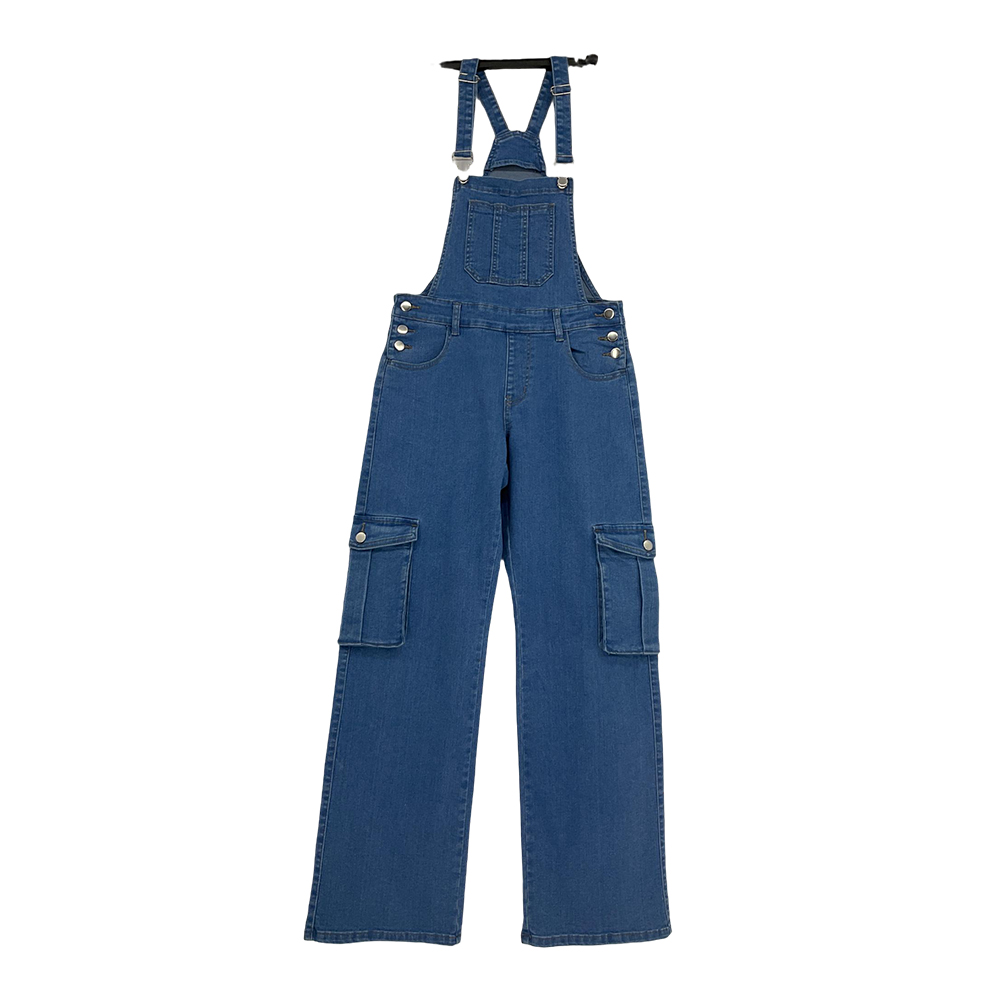
Women's Blue Denim Cargo Overalls with Wide Legs
Women's Jeans
-
+86-13717297921 WhatsApp
-
loveujeans@163.com Email
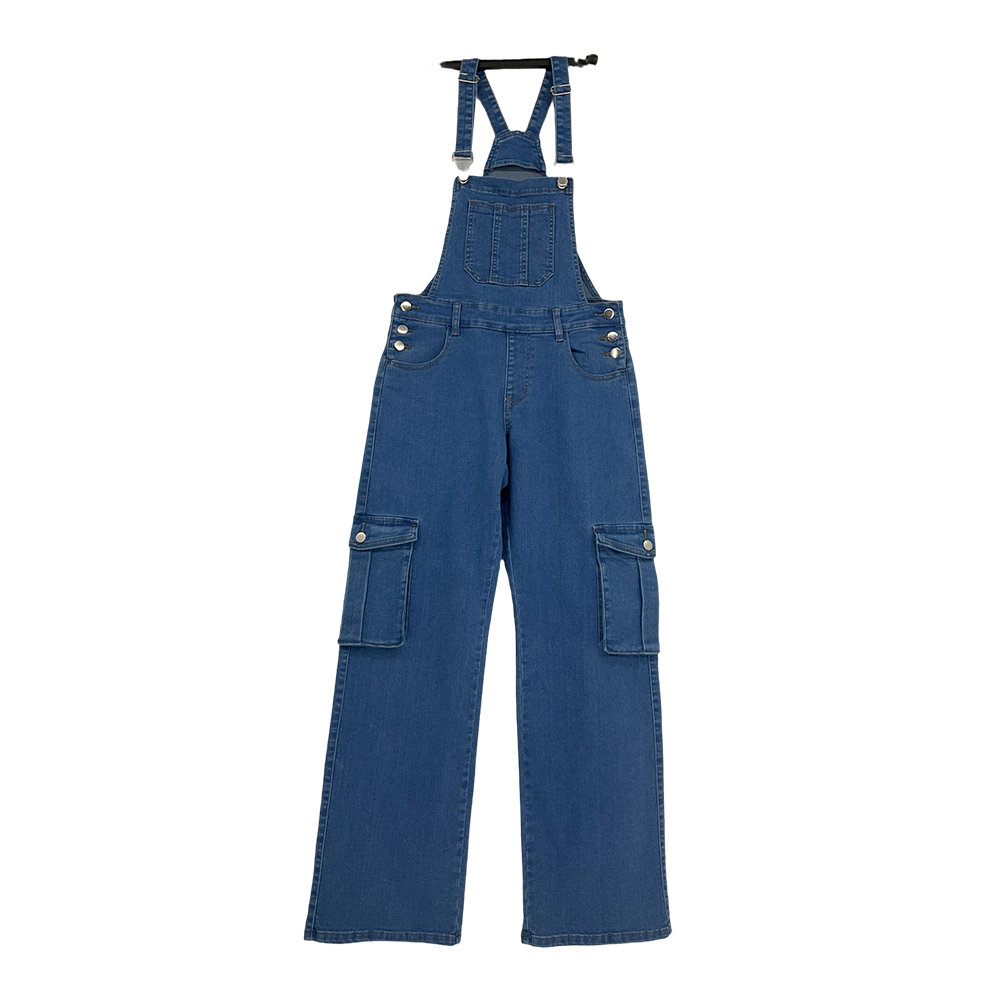
Women's Blue Denim Cargo Overalls with Wide Legs belong to the women's denim apparel category and combine a bib-front upper section with full-length trousers. The garment consists of adjustable shoulder straps, a bib panel, a front bib pocket, a waistband section, front and back trouser panels, side cargo pockets, and finished leg hems. Metal clasps connect the shoulder straps to the bib, while adjustment buckles allow changes to strap length. The upper bib features a vertically oriented patch pocket with visible stitching. Below the bib, the front waist area includes curved pockets, belt loops, and metal button fastenings at the sides. The trouser section extends into wide, straight-cut legs, with additional cargo pockets positioned on the outer thighs. Each cargo pocket has a flap secured by a metal button. The medium-blue denim surface has a relatively uniform wash, complemented by contrasting topstitching along the panel seams, pockets, waistband, and hems. In garment classification, this product can be described as women's denim overalls, wide-leg denim dungarees, bib-front cargo jeans, or full-length denim overalls. Product development documentation can include fabric composition, denim weight, stretch percentage, strap dimensions, pocket measurements, hardware specifications, garment length, and size grading. These details establish a clear reference for sampling, costing, and production planning. For apparel manufacturers and private-label brands, the style can be developed further through agreed changes to fabric, color, pocket configuration, trims, labels, and packaging. A complete technical pack helps buyers communicate specifications clearly and maintain consistency between approved samples and bulk production.
Women's Blue Denim Cargo Overalls with Wide Legs Specifications
| Specification | Details |
| Product Name | Women'S Blue Denim Cargo Overalls With Wide Legs |
| Product Category | Women'S Denim Apparel |
| Garment Type | Bib Overalls / Dungarees |
| Color | Medium Blue |
| Fabric | Denim |
| Fabric Composition | To Be Confirmed |
| Fabric Weight | To Be Confirmed |
| Stretch Content | To Be Confirmed |
| Fit | Relaxed Fit |
| Leg Style | Wide Leg |
| Length | Full Length |
| Shoulder Straps | Adjustable |
| Strap Hardware | Metal Clasps And Buckles |
| Bib Pocket | One Front Patch Pocket |
| Front Pockets | Two Curved Waist Pockets |
| Cargo Pockets | Two Outer-Thigh Cargo Pockets |
| Cargo Pocket Closure | Buttoned Flaps |
| Waist Closure | Side Metal Buttons |
| Belt Loops | Yes |
| Wash Finish | Medium Blue Denim Wash |
| Stitching | Contrasting Topstitching |
| Hem Finish | Straight Hem |
| Available Sizes | To Be Confirmed |
| OEM / ODM | Subject To Manufacturer Confirmation |
| Private Label | Subject To Agreement |
| Packaging | Subject To Agreement |
Women's Blue Denim Cargo Overalls with Wide Legs Features
1. Adjustable Straps
The adjustable shoulder straps connect the bib to the upper body through metal clasps and buckles. Their length can be modified to accommodate different fit preferences, making strap measurements an important part of product development. For wholesale and private-label orders, buyers should specify strap width, total length, adjustment range, buckle dimensions, and attachment positions in the garment technical pack. A provisional measurement tolerance of ±0.5–1 cm may be agreed upon for selected strap dimensions, subject to the approved sample. Quality inspection should verify that both straps have matching dimensions, adjustment hardware operates smoothly, and the clasps remain securely attached during normal handling. Stitching around the strap ends and bib attachment points should be checked for skipped stitches, loose threads, and uneven reinforcement. Manufacturers can record these details in the production specification to maintain consistency across different sizes. Before bulk approval, the finished sample should be assessed for strap positioning, bib alignment, and overall fit.
2. Spacious Cargo Pockets
Two large cargo pockets are positioned on the outer thighs, each featuring a flap with a metal button closure. Their placement creates a recognizable utility-inspired denim look while adding separate compartments to the trouser section. For product development, buyers can specify pocket width, height, depth, flap dimensions, button position, and distance from the side seam. A provisional placement tolerance of ±5 mm may be agreed upon for selected pocket details when appropriate to the design. During inspection, the left and right pockets should be compared for symmetry, consistent stitching, flap alignment, and secure button attachment. Pocket openings should remain functional, and the corners should be inspected for skipped stitches or loose threads. If a buyer requires a different cargo pocket profile, the pattern can be reviewed during sampling, subject to manufacturer capabilities. Documented measurements and reference photographs help maintain the intended pocket proportions throughout the agreed size range and subsequent bulk orders.
3. Relaxed Wide Legs
The trousers feature a wide-leg cut that extends from the upper leg toward the hem, creating a broader outline than slim or tapered denim overalls. This silhouette is defined by the leg pattern, crotch construction, inseam, outseam, and finished leg opening. Buyers should establish measurements for the waist, hip, front rise, back rise, thigh, knee, inseam, and hem circumference in the approved size chart. A provisional tolerance of ±1 cm may be agreed upon for selected points of measure, depending on the buyer's quality requirements. Sample fitting should include sitting, walking, and bending movements to assess comfort and check for excessive tension around the hips and crotch. Both legs should be compared for length, width, and seam alignment. Since denim washing may affect garment dimensions, post-wash measurements should be reviewed before production approval. A graded pattern and signed-off sample help manufacturers preserve the intended wide-leg proportions across different sizes.
4. Functional Bib Design
The upper bib features a rectangular patch pocket with visible vertical and horizontal stitching. This section connects to the shoulder straps above and the trouser body below, forming the defining construction of the overall garment. Buyers can specify bib width, bib height, pocket dimensions, neckline shape, strap attachment positions, and stitching details in the technical pack. A provisional placement tolerance of ±5 mm may be agreed upon for selected pocket and attachment points, subject to sample approval. During quality checks, the bib should be inspected for symmetry, smooth panel alignment, even stitching, and secure strap connections. The front pocket should be free from distorted edges, puckering, and skipped stitches. Metal clasps should be checked for correct engagement with the corresponding attachment points. For private-label projects, the bib pocket can be reviewed for alternative dimensions, label placement, or approved decorative details. Clear pattern measurements and construction instructions help maintain the intended bib shape across production batches.
5. Consistent Denim Finish
The medium-blue denim surface creates a consistent visual base across the bib, waistband, trouser panels, and cargo pockets. Contrasting topstitching outlines the seams and pocket edges, making stitching quality and shade consistency relevant points during production inspection. Buyers should approve a physical color sample under consistent lighting before bulk manufacturing begins. Colorfastness to washing can be assessed using ISO 105-C06, with the test procedure and acceptance grade agreed upon in advance. Dimensional changes can be evaluated using ISO 5077 with a specified washing and drying method. Post-wash inspection should include shade variation, seam appearance, strap dimensions, pocket alignment, and leg length. If the collection requires a lighter blue, darker indigo, or alternative wash effect, the manufacturer can review the requested finish during sampling, subject to available materials and processing capabilities. An approved color reference and written quality criteria help reduce unwanted variation between production batches and repeat orders.