
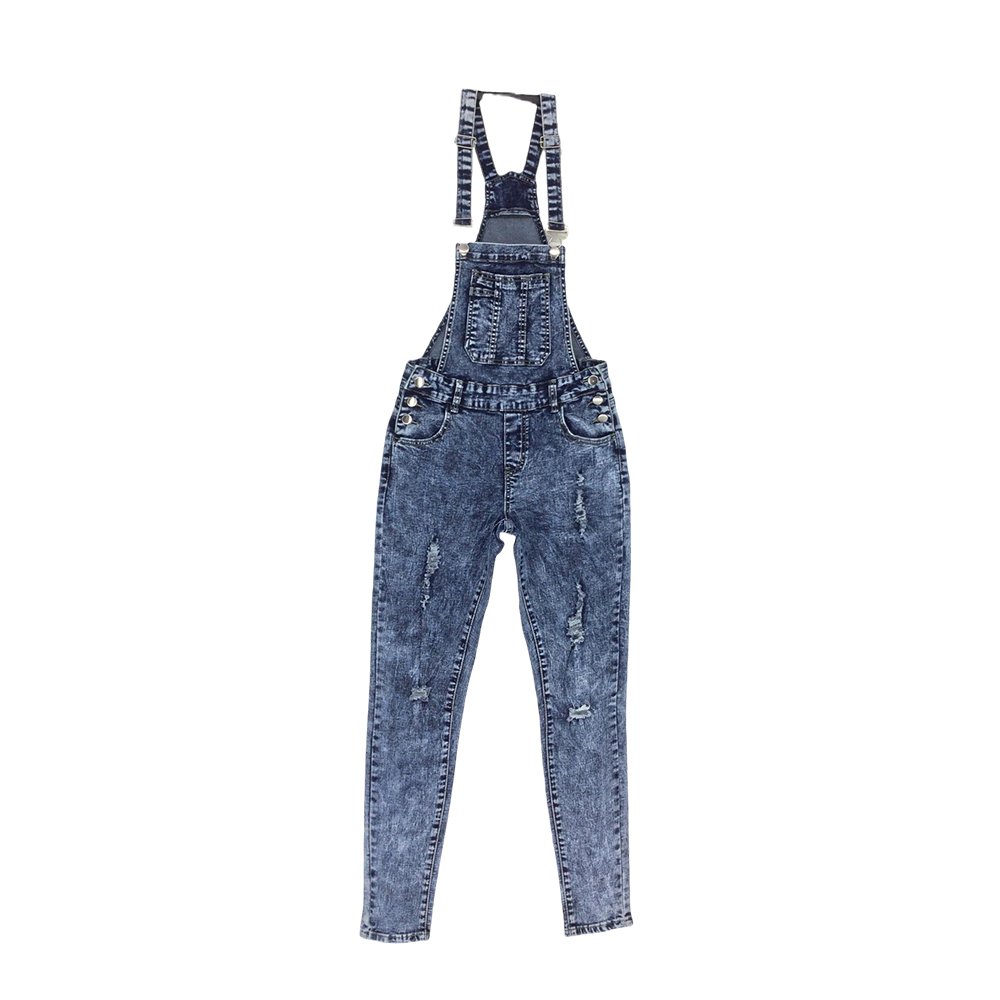
Women's Acid Wash Distressed Denim Overalls with Slim Legs
Women's Jeans
-
+86-13717297921 WhatsApp
-
loveujeans@163.com Email
Women's Acid Wash Distressed Denim Overalls are a one-piece denim garment featuring a bib-front upper section connected to full-length trousers. The garment is constructed from separate fabric panels, including the bib, shoulder straps, waistband, front and back trouser sections, and leg panels. Its front bib incorporates a rectangular patch pocket with visible vertical stitching. Adjustable shoulder straps connect to the bib through metal fasteners, forming the upper part of the garment. The waist section features belt loops, curved front pockets, metal buttons, and a central fly area. The back section is assembled with shaped panels and a rear waist section. The trouser legs follow a slim, tapered outline, narrowing gradually toward the ankle openings. Distressed details appear across the front leg panels, with irregular openings and frayed fabric edges distributed at selected positions. The denim surface features an acid-wash treatment that creates a mottled combination of lighter blue and deeper indigo shades. Contrasting topstitching outlines the pocket edges, panel seams, waistband, and hems. In apparel product classification, this style can be listed as women's denim overalls, acid-wash bib overalls, distressed denim dungarees, or slim-fit denim overalls. Product development specifications may include fabric composition, denim weight, stretch percentage, wash process, garment measurements, hardware materials, stitching details, and size grading. These technical details provide a reference for sample approval, costing, and bulk production planning. For manufacturers and private-label buyers, the garment can be developed through agreed adjustments to fabric, wash shade, distress placement, trims, labels, and packaging.
Women's Acid Wash Distressed Denim Overalls with Slim Legs Specifications
| Specification | Details |
| Product Name | Women'S Acid Wash Distressed Denim Overalls With Slim Legs |
| Product Category | Women'S Denim Apparel |
| Garment Type | Bib Overalls / Dungarees |
| Color | Acid-Wash Blue |
| Fabric | Denim |
| Fabric Composition | To Be Confirmed |
| Fabric Weight | To Be Confirmed |
| Stretch Content | To Be Confirmed |
| Fit | Slim Fit |
| Leg Style | Slim, Tapered Leg |
| Length | Full Length |
| Shoulder Straps | Adjustable |
| Strap Fasteners | Metal Hardware |
| Bib Pocket | One Front Patch Pocket |
| Front Pockets | Two Curved Pockets |
| Back Pockets | To Be Confirmed |
| Waistband | Belt Loops With Button Closure |
| Fly | Front Fly Construction |
| Surface Finish | Acid Wash |
| Distressed Details | Frayed Openings On Front Leg Panels |
| Stitching | Contrasting Topstitching |
| Hem Finish | Stitched Hem |
| Available Sizes | To Be Confirmed |
| OEM / ODM | Subject To Manufacturer Confirmation |
| Private Label | Subject To Agreement |
| Packaging | Subject To Agreement |
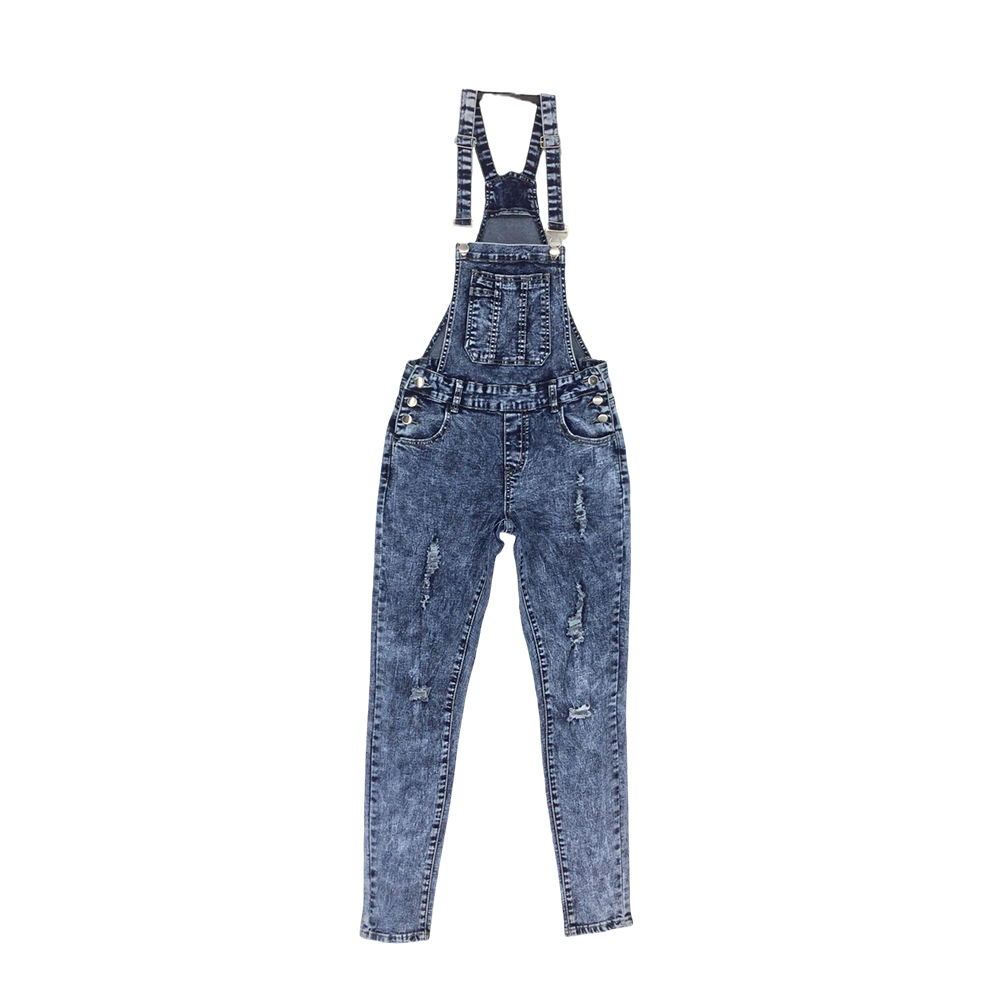
Women's Acid Wash Distressed Denim Overalls with Slim Legs Features
1. Adjustable Fit
The adjustable shoulder straps allow the wearer to modify the bib's position and overall upper-body fit. Metal fasteners connect the straps to the bib, creating an adjustable connection that can be checked during garment fitting and production inspection. For wholesale and private-label development, buyers should specify strap width, total length, adjustment range, buckle dimensions, and attachment positions in the technical pack. A provisional measurement tolerance of ±0.5–1 cm may be agreed upon for selected strap dimensions, subject to the approved sample. Quality checks should verify that both straps have matching lengths, the adjustment hardware moves smoothly, and the attachment points remain secure during normal use. Stitching at the strap ends and bib connections should be inspected for skipped stitches, loose threads, and uneven reinforcement. Before bulk approval, the garment should be fitted across the intended size range to review strap positioning, bib coverage, and waist alignment. These checks help maintain consistent proportions across production batches.
2. Distressed Finish
The front leg panels feature irregular distressed openings with frayed fabric edges, creating variation across the acid-wash denim surface. Distressing is a pattern-controlled finishing detail, so its location, dimensions, and density should be documented before bulk production. Buyers can specify the number of distressed areas, their distance from the inseams and side seams, opening length, and approximate width. A provisional placement tolerance of ±5 mm may be agreed upon for selected distress positions when suitable for the design. During sample inspection, each opening should be checked for loose fibers, uneven edges, and unintended damage beyond the approved area. If the garment uses a stretch-denim blend, the backing and yarn structure around distressed sections should be reviewed to reduce excessive opening growth during wear. Manufacturers can use reference photographs and a signed-off sample to guide repeat production. This process helps preserve the intended distressed appearance while controlling differences between individual garments.
3. Slim Silhouette
The trouser section follows a slim, tapered shape, with the legs narrowing toward the ankle openings. This silhouette depends on the pattern proportions, including hip width, thigh circumference, knee width, inseam, outseam, and leg opening. For accurate bulk production, buyers should establish a size chart covering waist, hip, front rise, back rise, thigh, knee, inseam, and finished hem circumference. A provisional tolerance of ±1 cm may be agreed upon for selected points of measure, depending on the buyer's specifications. Sample fitting should include sitting, walking, and bending movements to assess ease around the hips, crotch, knees, and calves. Both legs should be checked for matching lengths, balanced seam lines, and consistent tapering. Because washing and finishing can change denim dimensions, post-wash measurements should be recorded before final production approval. A graded pattern and approved fit sample help maintain the intended slim profile across the agreed size range.
4. Functional Bib
The front bib features a rectangular patch pocket with visible vertical stitching and adjustable straps attached at the upper corners. Its dimensions and position influence the garment's overall proportions, making the bib a key measurement area during sampling. Buyers can specify bib width, bib height, pocket width, pocket depth, strap attachment distance, and stitching layout in the technical pack. A provisional placement tolerance of ±5 mm may be agreed upon for selected pocket and attachment points, subject to sample approval. Inspection should check pocket symmetry, straight stitch lines, smooth panel edges, and secure strap fasteners. The bib pocket should retain its intended shape without excessive puckering or distorted corners. For private-label projects, pocket dimensions, label placement, and decorative stitching can be adjusted according to the approved artwork and pattern. Clear construction instructions and reference measurements help the manufacturer reproduce the bib consistently across sizes and repeat orders.
5. Acid-Wash Appearance
The acid-wash finish creates a mottled blue surface with lighter areas contrasting against deeper indigo tones. The visible pattern extends across the bib, waistband, pocket sections, and trouser legs, giving the garment a varied denim appearance. For bulk orders, buyers should approve a physical wash sample and define acceptable shade variation before production begins. Where relevant to the fabric and finishing process, colorfastness to washing can be evaluated using ISO 105-C06, with the test method and acceptance grade agreed upon in advance. Dimensional changes after washing can be assessed using ISO 5077 under a specified washing and drying procedure. Inspection should review shade consistency, seam appearance, pocket alignment, hem dimensions, and distress placement after finishing. If a collection requires a lighter wash, darker indigo contrast, or different distress intensity, the requested finish can be evaluated during sampling, subject to manufacturer capabilities. An approved color reference and documented finishing instructions help control variation across production batches.