
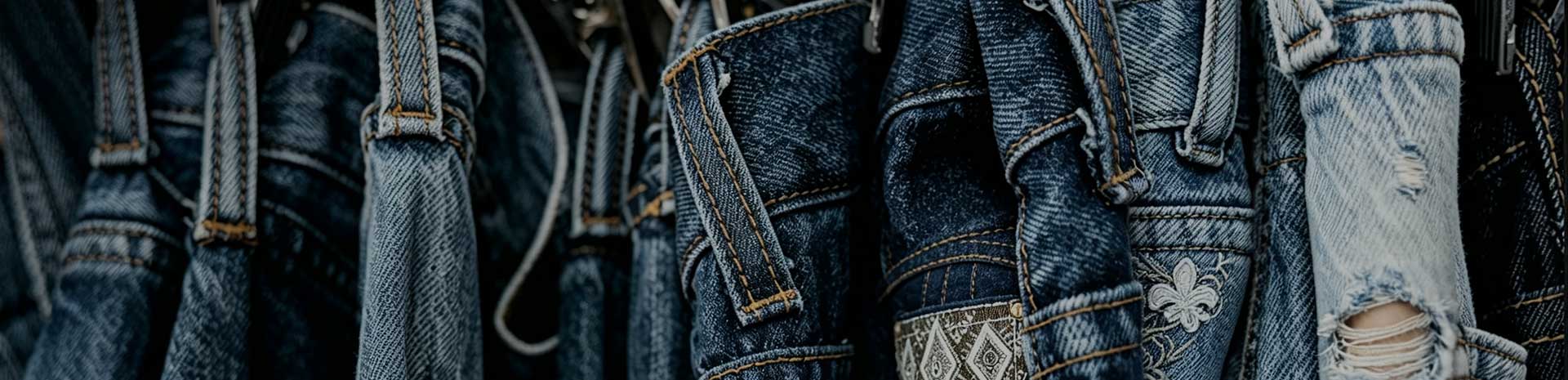
Embroidered Pocket Jeans vs Plain Pocket Jeans: Which Adds More Value to a Denim Collection?
Embroidered pocket jeans add distinctive visual and branding value to fashion-focused denim collections, while plain pocket jeans provide broader styling flexibility and simpler production requirements. For wholesale buyers, the better choice depends on target customers, embroidery quality, manufacturing costs, retail positioning, and whether decorative details justify a higher selling price.
What Is the Difference Between Embroidered Pocket Jeans and Plain Pocket Jeans?
The main difference between embroidered pocket jeans and plain pocket jeans is the decorative treatment applied to the garment pockets. Embroidered pocket jeans feature stitched patterns, logos, or ornamental motifs, while plain pocket jeans generally retain conventional pocket construction with minimal decoration.
Both styles can use similar denim fabrics, fits, washing treatments, and garment construction methods.
The distinction lies mainly in pocket appearance, additional manufacturing operations, and the opportunities for product differentiation.
Embroidered pocket jeans may feature floral patterns, geometric motifs, decorative stitching, or custom brand artwork. The embroidery can be applied to one or both back pockets, depending on the intended design.
Plain pocket jeans commonly feature standard patch pockets with basic reinforcement and topstitching. Some may include a simple signature stitch, but the overall appearance remains relatively understated.
For clothing brands and wholesale distributors, these differences can influence product development, production costs, customer positioning, and repeat-order consistency.
| Comparison Factor | Embroidered Pocket Jeans | Plain Pocket Jeans |
|---|---|---|
| Pocket Appearance | Decorative embroidery or motifs | Minimal decoration |
| Design Flexibility | Artwork, thread colors, stitch patterns | Pocket shape and basic stitching |
| Brand Differentiation | Greater visual identification potential | Relies more on fit, wash, and overall styling |
| Production Operations | Additional embroidery preparation and sewing | Conventional pocket construction |
| Manufacturing Cost | May increase with embroidery complexity | Generally fewer decorative operations |
| Quality Inspection | Embroidery alignment, thread quality, pocket construction | Pocket placement and sewing consistency |
| Customization | Custom embroidery and decorative elements | Custom shape, stitching, and labels |
| Retail Positioning | Decorative and fashion-focused denim | Classic and minimalist denim |
| Repeat Production | Requires approved artwork and embroidery specifications | Requires approved pocket pattern and construction |
The commercial value of either style depends on how well it matches the brand's target customers.
Why Can Embroidered Pocket Jeans Add More Value to a Denim Collection?
Embroidered pocket jeans can increase a collection's perceived design value by introducing visible details that distinguish one product from another.
Back pockets occupy a recognizable position on jeans, making decorative embroidery a noticeable element of the garment's overall appearance.
For fashion brands, embroidery creates an opportunity to establish recognizable design characteristics without changing the entire jeans silhouette.
A dark indigo bootcut style with floral embroidery, for example, can occupy a different merchandising position from a plain-pocket version using similar denim and garment measurements.
The decorative design can also be adapted across multiple products within a collection.
A brand may use related embroidery motifs on skinny jeans, bootcut jeans, denim skirts, and other denim garments to create a coordinated visual identity.
However, added decoration does not automatically increase the selling price or profitability.
Retail customers must consider the embroidery attractive and relevant to the brand's positioning.
If the additional production cost exceeds the premium customers are willing to pay, the decorative feature may reduce profitability.
For wholesale buyers, embroidered pockets create value when they support a clear product identity and an appropriate retail price.
Why Do Plain Pocket Jeans Remain Important for Denim Brands?
Plain pocket jeans remain relevant because they allow the garment's fit, fabric, washing treatment, and construction to define its appearance.
Their understated design can be incorporated into different fashion directions without relying on prominent pocket decoration.
For example, dark wash straight-leg jeans with plain back pockets may suit a classic denim collection.
Light wash wide-leg jeans with similarly understated pockets can represent a more relaxed product category.
This flexibility makes plain pocket jeans suitable for brands that prioritize simple styling or want to develop several denim silhouettes with a consistent visual approach.
From a manufacturing perspective, plain pockets generally require fewer decorative operations.
The producer can focus on pocket dimensions, placement, stitching, seam reinforcement, and garment finishing.
However, plain pockets are not necessarily easier to produce to a high standard.
Because they contain fewer decorative elements, irregular stitching, uneven pocket placement, and fabric puckering may become more noticeable.
For brands selling minimalist denim, pocket construction quality remains a significant part of the finished product.
How Does Pocket Embroidery Affect the Appearance of Women's Jeans?
Pocket embroidery changes the visual emphasis of the back section of women's jeans.
The effect depends on the pattern, thread color, motif size, embroidery placement, and contrast with the denim fabric.
Light-colored embroidery can stand out against dark indigo denim, while embroidery using colors close to the base fabric may create a subtler result.
Floral motifs may support decorative or vintage-inspired styling, while geometric embroidery can produce a different visual character.
The relationship between the embroidered design and pocket shape is particularly relevant.
A motif that appears balanced on a large back pocket may look crowded when transferred to a smaller pocket without adjustment.
The embroidery should therefore be evaluated on the actual pocket pattern.
For private-label development, buyers can specify the artwork dimensions, thread colors, stitch direction, and location within the pocket.
A physical embroidery sample provides more reliable information than evaluating the artwork only on a computer screen.
The finished result should be reviewed after any required washing or garment finishing operations.
How Are Embroidered Back Pockets Manufactured?
Embroidered back pockets generally require additional preparation before the pockets are attached to the garment.
In a common production sequence, the embroidery design is converted into a machine-readable stitch file, tested on the selected denim, and approved before bulk embroidery begins.
The actual sequence may vary according to the embroidery equipment, garment construction, and finishing method.
What Happens During Embroidery Preparation?
The development process begins with the approved artwork.
The manufacturer evaluates the motif dimensions, stitch types, thread colors, and fabric characteristics.
The design must then be digitized into instructions suitable for the embroidery machine.
During sample preparation, thread tension, stitch density, needle selection, and fabric stabilization may need adjustment.
Dense embroidery on relatively lightweight or stretch denim can cause puckering if the fabric is not properly supported.
The selected stabilizer and embroidery parameters should therefore be tested on the actual production fabric.
Why Is Pocket Embroidery Often Completed Before Pocket Attachment?
Applying embroidery to a flat pocket panel can simplify positioning and machine operation.
It also allows the manufacturer to inspect the decorative design before attaching the pocket to the jeans.
However, the embroidery process must account for the pocket's final seam allowances and folding areas.
A motif placed too close to the finished edge may become partially concealed when the pocket is sewn.
For bulk production, the approved embroidery sample should identify the artwork placement relative to the finished pocket boundaries.
This creates a repeatable reference for cutting, embroidery, and sewing operations.
What Embroidery Parameters Should Wholesale Buyers Confirm?
Wholesale buyers should specify embroidery requirements before sample approval because changes to the artwork or stitch construction can affect production costs and finished appearance.
Important parameters include motif dimensions, thread colors, stitch count, placement, thread type, and fabric compatibility.
For example, a decorative motif measuring approximately 8 × 6 cm may require a different stitch count and production time from a larger motif measuring 12 × 10 cm.
These dimensions are illustrative development examples rather than standard pocket embroidery sizes.
The appropriate motif size depends on the pocket measurements and desired visual effect.
| Embroidery Parameter | What Buyers Should Confirm |
|---|---|
| Artwork Dimensions | Width and height of the finished motif |
| Thread Material | Approved embroidery thread specification |
| Thread Colors | Exact shades or approved physical references |
| Stitch Count | Based on the finalized digitized artwork |
| Stitch Density | Suitable for the selected denim and motif |
| Placement | Distance from pocket edges and reference points |
| Fabric Stabilization | Suitable method for controlling distortion |
| Embroidery Backing | Agreed backing type and finishing method |
| Edge Appearance | Clean motif boundaries and acceptable thread ends |
| Final Inspection | Artwork consistency, puckering, and thread defects |
Stitch count alone does not determine embroidery quality.
A dense design may require more stitches, but excessive density can create stiffness, distortion, or uneven fabric behavior.
The correct embroidery specification balances appearance, fabric characteristics, production efficiency, and the garment's intended use.
Are Embroidered Pocket Jeans More Expensive to Manufacture?
Embroidered pocket jeans often involve higher decorative processing costs than comparable plain pocket jeans.
Additional expenses may include artwork digitizing, embroidery thread, machine time, stabilizing materials, sampling, and inspection.
However, the price difference depends on embroidery complexity and the complete garment specification.
A small single-color motif may require relatively little additional processing.
A large multicolor design with dense stitching and decorative elements can involve more material and production time.
For example, an embroidery design requiring 5,000 stitches will generally have different processing requirements from a design requiring 20,000 stitches, assuming comparable equipment and operating conditions.
These are illustrative stitch counts rather than verified specifications for a particular jeans product.
The final quotation should be based on the approved artwork and production sample.
Buyers should also consider the base garment.
Plain pocket jeans manufactured with expensive fabrics, specialized washing, or complex construction may cost more than simpler embroidered jeans.
Therefore, wholesale price comparisons should use equivalent fabric, wash, fit, size range, order quantity, and packaging specifications.
The relevant question is whether the embroidery adds sufficient commercial value to justify its additional cost.
Can Embroidered Pockets Support Higher Retail Prices?
Embroidered pockets may support higher retail prices when customers recognize the decoration as a desirable design feature.
However, embroidery alone does not guarantee a price premium.
Retail value depends on the brand's positioning, customer preferences, overall garment quality, and competitive environment.
A boutique specializing in decorative women's denim may find embroidered pockets particularly suitable for its assortment.
A retailer emphasizing minimalist jeans may have less demand for the same design.
Wholesale buyers should evaluate expected retail pricing before finalizing embroidery specifications.
A practical approach is to compare two jeans samples with similar fabrics, fits, and washes but different pocket treatments.
The buyer can then assess customer reactions, perceived design value, and acceptable price differences.
If customers are unwilling to pay enough to cover the additional manufacturing and distribution costs, a more restrained embroidery design may be commercially appropriate.
In this context, product value should be measured through contribution margin and customer demand, not simply the presence of decorative workmanship.
How Does Embroidery Affect Denim Fabric Performance?
Embroidery introduces additional stitches into the denim fabric, changing how the decorated area behaves.
The effect depends on the selected denim, stitch density, backing materials, and embroidery construction.
On rigid denim, dense motifs may create localized stiffness.
On stretch denim, embroidery can restrict elasticity in the decorated section if the stitch construction does not accommodate movement.
Poorly controlled embroidery may also cause fabric puckering, distortion, or unwanted tension around the pocket.
Manufacturers should evaluate these factors during sample development.
The embroidery sample should be checked for smoothness, stability, thread tension, and changes after washing.
For jeans that undergo garment washing after embroidery, thread colorfastness and the condition of decorative stitches deserve particular attention.
Testing requirements should reflect the actual materials and finishing process.
For example, ISO 105-C06 may be used to evaluate relevant colorfastness properties under an agreed laundering procedure.
Dimensional changes can be evaluated using ISO 5077 where appropriate.
These standards do not establish universal acceptance criteria for every embroidered jeans design.
The buyer and manufacturer should define suitable requirements for the finished product.
Which Pocket Style Is Easier to Control During Bulk Production?
Plain pocket jeans generally involve fewer production variables because they do not require additional embroidered artwork.
However, both pocket styles require accurate cutting, positioning, and sewing.
For plain pockets, the manufacturer should control pocket width, height, shape, seam allowance, and placement.
For embroidered pockets, the same construction checks are necessary, together with embroidery-specific inspections.
These may include motif positioning, thread consistency, missing stitches, backing condition, and fabric puckering.
A pocket can have technically acceptable embroidery but still appear defective if attached unevenly to the garment.
This highlights an important production distinction:
Embroidery quality and pocket assembly quality must be inspected separately before evaluating the completed jeans.
For example, a buyer may establish a provisional placement tolerance of ±5 mm for selected pocket or motif positions during development.
The actual tolerance depends on the pocket dimensions, design complexity, garment size, and approved specification.
Such values should be treated as agreed production requirements rather than universal industry standards.
A signed-off sample and clear measurement sheet help reduce differences between production batches.
Does Embroidery Placement Affect the Fit and Appearance of Jeans?
Embroidery placement primarily affects garment appearance, but the pocket's location and construction can also influence how the rear section sits against the body.
Back pockets are attached to shaped garment panels, often near the yoke and seat areas.
Their size, angle, and position should be established according to the jeans pattern.
A decorative motif must remain visually balanced after the pocket is sewn onto the garment.
For example, a centered embroidery design may appear uneven if the pocket is rotated or attached at a different angle from the approved sample.
The problem may originate in pocket assembly rather than the embroidery operation.
For fitted jeans, the curvature of the garment around the seat can also affect how the decorative design appears when worn.
Manufacturers should therefore assess the finished garment on an appropriate fit model or form.
Reviewing an embroidered pocket as a flat fabric panel is useful, but it should not replace inspection after garment assembly.
For private-label collections, the final approval should include the embroidery, pocket placement, and overall back-panel appearance.
Which Jeans Silhouettes Work Best with Embroidered Pockets?
Embroidered pockets can be incorporated into several women's jeans silhouettes, including skinny, straight-leg, bootcut, and flared styles.
The most suitable combination depends on the intended fashion direction.
Skinny jeans with embroidered back pockets may emphasize decorative details against a fitted silhouette.
Bootcut jeans can combine modest lower-leg widening with ornamental pocket designs.
Flared jeans may use embroidery as part of a retro-inspired appearance.
Straight-leg jeans can incorporate simple geometric motifs without changing their overall classic proportions.
| Jeans Style | Embroidered Pocket Direction | Plain Pocket Direction |
|---|---|---|
| Skinny Jeans | Decorative fitted denim | Minimalist fitted denim |
| Straight-Leg Jeans | Subtle branding or motifs | Classic casual styling |
| Bootcut Jeans | Floral or geometric decoration | Traditional denim appearance |
| Flared Jeans | Vintage-inspired embroidery | Silhouette-focused styling |
| Dark Wash Jeans | High-contrast embroidery | Understated indigo finish |
| Light Wash Jeans | Coordinated thread-color decoration | Relaxed casual appearance |
These combinations are design possibilities, not verified rankings of customer demand.
A brand should select embroidery according to its intended customer group and product positioning.
Are Plain Pocket Jeans Better for Minimalist Fashion Collections?
Plain pocket jeans are generally more suitable for collections that prioritize simple construction details and understated styling.
Without prominent embroidery, attention shifts toward garment fit, denim texture, wash shade, and sewing quality.
For brands pursuing a minimalist direction, plain pockets can support a consistent appearance across several products.
However, plain pockets do not have to be completely undecorated.
Subtle contrast stitching, modified pocket shapes, or a restrained signature stitch may create brand recognition without the visual intensity of a larger embroidered motif.
The distinction between plain and decorative pockets should therefore be defined in the product specification.
For wholesale purchasing, a minimalist collection may benefit from using related pocket patterns across multiple jeans styles.
This can simplify development and help maintain a coordinated product appearance.
Nevertheless, each garment still requires individual fit, placement, and measurement approval.
Using a common pocket design does not eliminate the differences between skinny, straight-leg, and bootcut patterns.
Which Style Has Greater Potential for Private Label Denim Brands?
Both styles provide customization opportunities, but they support different branding strategies.
Embroidered pocket jeans allow brands to incorporate distinctive motifs, decorative artwork, and recognizable stitching patterns.
Plain pocket jeans allow branding to be expressed through garment silhouettes, denim finishes, labels, hardware, and subtle construction details.
For a private-label brand seeking highly recognizable decorative jeans, custom embroidery may be a useful product-development investment.
For a brand emphasizing classic denim, plain pockets may better support its visual direction.
The decision should also consider repeat production.
Complex embroidery requires the manufacturer to maintain approved artwork files, thread references, stitch settings, and placement specifications.
Plain pockets require approved patterns, stitching details, and accurate positioning.
At LOVEU JEANS, buyers can discuss different pocket treatments alongside fabric selection, jeans silhouettes, washing effects, and private-label requirements.
Custom embroidery development should begin with the buyer's artwork or reference sample.
The design can then be evaluated for dimensions, stitch construction, fabric compatibility, and production feasibility before commercial quantities are confirmed.
How Can Denim Brands Combine Both Pocket Styles in One Collection?
A denim collection can include both embroidered and plain pocket jeans when the products target different customer preferences.
Plain pocket jeans may form a classic assortment, while embroidered versions introduce more decorative styling.
For example, a brand may develop plain-pocket straight-leg jeans in dark indigo and embroidered bootcut jeans in medium blue.
Another collection may use a similar jeans silhouette with two different pocket treatments to evaluate customer preferences.
The products can be differentiated through embroidery, wash shade, stitching, and hardware while retaining selected shared materials.
From a manufacturing standpoint, buyers may coordinate fabric sourcing, buttons, labels, and packaging when the specifications permit.
However, each decorative variation should have its own approved sample and quality requirements.
A plain-pocket version and an embroidered-pocket version should not be treated as completely interchangeable production products.
The embroidery operation can affect pocket preparation, production scheduling, quality inspection, and final costing.
Clear documentation helps buyers manage both variations within a coordinated wholesale collection.
What Should Buyers Check Before Ordering Embroidered Pocket Jeans?
Before confirming a bulk order, buyers should review the embroidery sample and finished jeans construction.
The artwork should match the approved design, including motif shape, thread colors, dimensions, and placement.
The manufacturer should also confirm that the embroidery is compatible with the selected denim and washing treatment.
A useful pre-production review covers the following areas:
Approved embroidery artwork and stitch file.
Thread colors and material specifications.
Motif dimensions and placement.
Pocket dimensions and sewing requirements.
Fabric compatibility and stabilization.
Embroidery appearance after washing.
Acceptable variation between finished garments.
Quantity, packaging, and production requirements.
For plain pocket jeans, buyers should focus on pocket symmetry, stitching appearance, reinforcement, seam alignment, and finished garment measurements.
Both styles should undergo inspection according to their approved specifications.
For embroidered denim, an additional consideration is whether the approved artwork can be reproduced consistently across different pocket sizes.
A motif that works on the base sample may need adjustment for significantly smaller or larger sizes.
This should be resolved during size grading and pre-production approval rather than after bulk manufacturing begins.
Which Pocket Style Has Better Potential for Wholesale Buyers?
Plain pocket jeans may support broader assortment flexibility because they fit classic, casual, and minimalist product categories.
Embroidered pocket jeans may provide stronger differentiation for retailers focusing on decorative and fashion-led denim.
However, neither pocket style guarantees higher sales.
Wholesale buyers should evaluate customer preferences, selling prices, production costs, and inventory performance.
For example, a distributor supplying traditional denim retailers may find plain-pocket jeans more suitable.
A boutique serving customers who prefer decorative back pockets may place greater emphasis on embroidered styles.
The purchasing decision should reflect verified demand rather than assuming that added decoration always creates a more valuable product.
Brands can compare similar jeans silhouettes with different pocket treatments through limited product trials.
Relevant performance indicators include sell-through rates, reorder frequency, customer feedback, returns, and gross profit per garment.
These results can reveal whether embroidery contributes measurable commercial value within the intended market.
Embroidered Pocket Jeans vs Plain Pocket Jeans: Which Adds More Value to a Denim Collection?
Embroidered pocket jeans can add greater visual and brand differentiation, particularly for fashion-focused collections. Plain pocket jeans provide broader styling flexibility and generally require fewer decorative manufacturing operations.
For denim brands, the better choice depends on how the product will be positioned and priced.
Embroidery can justify additional production investment when customers value the decorative design and are willing to pay an appropriate retail price.
Plain pockets may be more commercially effective when the collection emphasizes classic styling, garment fit, and understated details.
From a manufacturing perspective, embroidered pockets require additional control of artwork, thread selection, placement, fabric stability, and finishing compatibility.
Plain pockets still require accurate construction, symmetry, and sewing quality.
A practical sourcing principle is to evaluate decorative features according to their contribution to the finished product, not simply the number of manufacturing operations involved.
For wholesale buyers, the most valuable jeans style is the one that matches customer expectations while maintaining acceptable quality, production cost, and commercial margins.
Develop Custom Embroidered and Plain Pocket Jeans with LOVEU JEANS
LOVEU JEANS supports denim product development discussions for clothing brands, wholesalers, importers, and distributors seeking different women's jeans silhouettes and pocket designs.
Our team can discuss embroidered back pockets, classic pocket construction, contrasting stitching, decorative hardware, and washing finishes according to the buyer's reference samples and product requirements.
Custom development may involve skinny jeans, straight-leg jeans, bootcut jeans, flared jeans, and other denim categories.
For embroidered styles, buyers can provide artwork, preferred thread colors, pocket measurements, and target garment specifications.
For plain-pocket styles, development discussions may focus on pocket shape, placement, stitching, denim fabric, and overall fit.
An approved sample and technical specification provide the reference for costing, production planning, and quality inspection.
Contact LOVEU JEANS to discuss custom denim pocket designs, request a wholesale quotation, and share your OEM/ODM requirements for your next women's denim collection.